


 +91-85304 14111




OUR BLOGS
Our Latest Blogs
17 Aug 2026
By Mansi Jha l Construction
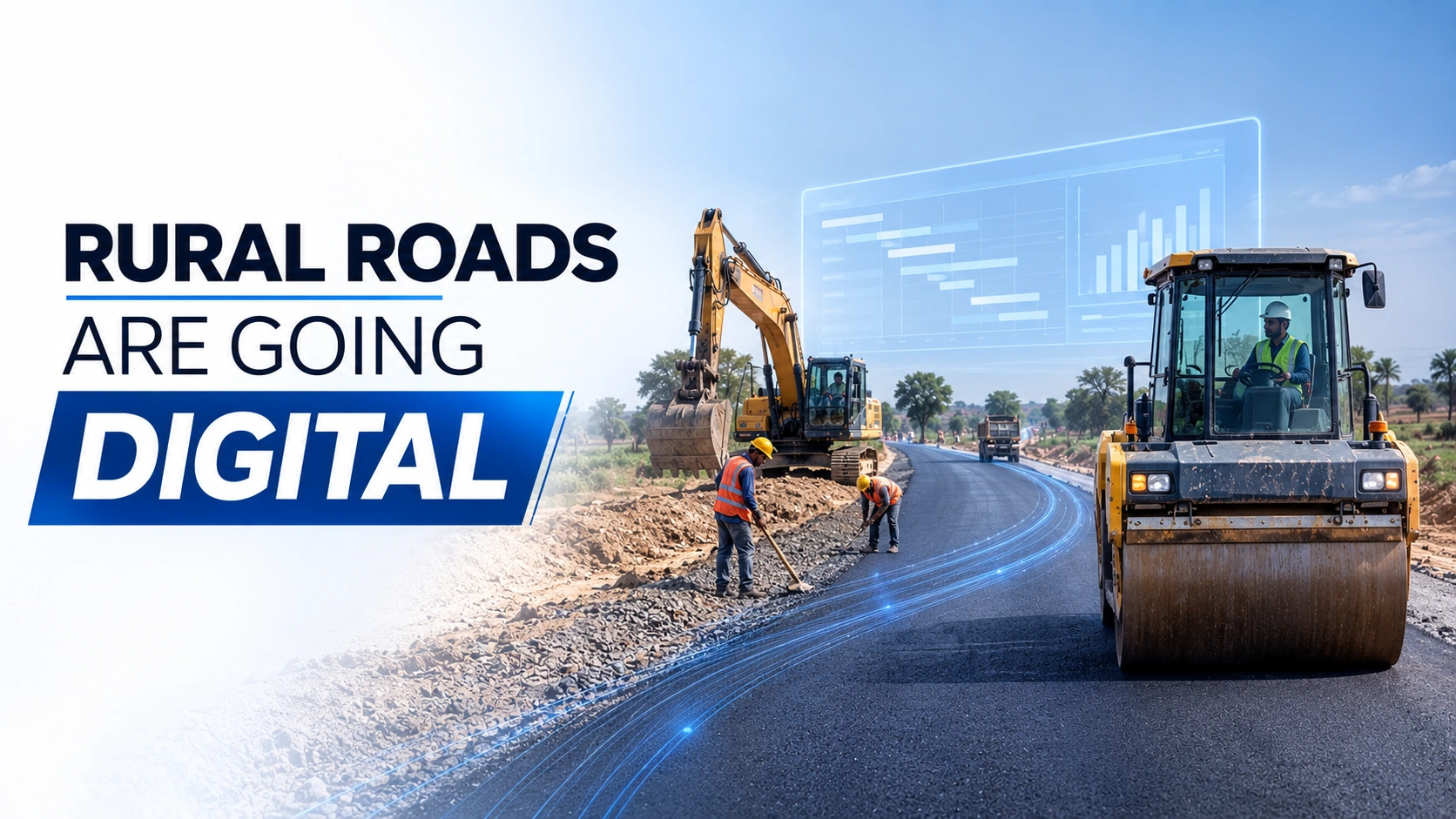
India's Rural Road Construction Is Going Digital: What PMGSY's New Modules Mean for Construction Management
If you run a construction or infrastructure business in India, you have probably felt this pain firsthand: a measurement gets recorded on site, it sits in a physical measurement book for days, and by the time it reaches the billing desk, nobody is quite sure what has actually been verified and what is still pending. That gap between site execution and financial reporting is exactly what the government is now trying to close at a national scale, and it says a lot about where construction ERP is headed for every contractor, developer, and infrastructure firm in the country.
On August 17, 2026, the Ministry of Rural Development announced two new digital modules under the Pradhan Mantri Gram Sadak Yojana (PMGSY): the electronic Measurement Book (e-MB) and electronic billing (e-billing). Built by the National Rural Infrastructure Development Agency (NRIDA), these modules replace a paper-based measurement and billing process that had been in place for almost two decades.
The news is specific to rural roads, but the underlying shift is not. It is a preview of where every part of India's construction industry is heading: away from paper files and disconnected spreadsheets, and toward connected digital systems built around a construction ERP.
Why PMGSY's Digital Shift Matters
PMGSY has been central to India's rural infrastructure story since it launched in 2000. The scheme has helped build close to one lakh kilometres of roads and connect around 1.63 lakh habitations. Coordinating work at that scale means constant back and forth between field teams, contractors, engineers, and government agencies.
Every manual handoff in that chain is a place where delays, duplication, and billing errors can creep in. When measurement, verification, billing, and payment all move through paper, it becomes hard to answer a simple question: what has actually been completed, what has been verified, and what is still owed?
Digital workflows change that equation. Once data is captured digitally and shared with the right stakeholders as part of one connected process, you get a real information trail instead of a stack of files. That is a big deal for an industry where timelines, costs, and resources are this tightly linked.
From Paper-Based Processes to Digital Construction Management
Construction has always run on documentation: measurement books, purchase orders, invoices, material records, completion reports, bills, and progress updates. None of that information is the problem. The problem is what happens when it lives in different places.
A project manager tracks materials in one spreadsheet. Finance keeps invoices in a separate system. Procurement logs purchase orders on its own. Site engineers record execution data on paper or in a standalone app. Each of these processes might work fine on its own, but the project itself does not run in silos.
A delay in procurement affects material availability. Material availability affects site execution. Execution affects progress. Progress affects billing. Billing affects cash flow. When these dependencies are invisible, teams end up reacting to problems instead of catching them early, which is one of the core issues we unpacked in our guide to top procurement challenges in construction and how biCanvas fixes them. Construction digitalisation is moving past simple automation of single tasks and toward connecting the entire project lifecycle, which is really the whole premise behind construction ERP.
What Is an Electronic Measurement Book?
A Measurement Book, or MB, records the measurements of completed work and forms the basis for verification and payment. Digitising this process cuts down on physical paperwork and makes project information far easier to trace.
According to the Ministry, the new e-MB module is designed to reduce duplication, minimise manual errors, and create a reliable audit trail, while also supporting centralised monitoring of rural road projects. This matters beyond the measurement stage itself. Measurement data feeds directly into progress reporting, contractor billing, cost tracking, and financial management. When it is digitally connected to those downstream processes, the gap between what happens on site and what shows up in the records shrinks considerably.
Why Digital Billing Matters in Construction
Billing sits right next to measurement in importance. Contractor payments depend on completed and verified work, and any delay or mismatch in the flow from measurement to verification to billing hits cash flow and project administration hard.
The e-billing module is built to digitise this exact stage. Together, e-MB and e-billing create one connected workflow from field measurement through to payment, which the government says is meant to simplify the process while strengthening transparency and accountability.
The lesson for construction businesses is straightforward: digitalisation gets more valuable when processes are connected rather than digitised in isolation. Turning a paper form into a digital form is a small win. Linking that digital data to procurement, finance, execution, and reporting is where the real gains show up, especially for contractors already managing complex subcontractor RA billing cycles.
Construction Projects Need More Than Individual Digital Tools
Plenty of construction companies already use digital tools, from accounting software to spreadsheets for budgeting, standalone procurement systems, and messaging apps for site communication. The trouble is that scattered digital tools do not automatically add up to digital visibility. If the information stays split across systems, teams still burn hours collecting, comparing, and reconciling data by hand.
That challenge only grows as a business scales. A company running multiple projects needs to track project budgets, purchase orders, vendor commitments, material receipts, inventory levels, site consumption, labour and resources, contractor bills, project expenses, work progress, cash flow, and profitability, all at once. Every one of these is connected, and a change in one ripples into several others. This is exactly where a construction ERP earns its place.
The Role of Construction ERP in Digital Transformation
A construction ERP brings core business and project processes into one shared environment instead of treating procurement, inventory, finance, and execution as separate functions. For construction companies, that means connecting project planning, purchasing, material management, inventory, finance, budgeting, and analytics under a single operational framework.
The point is not simply having more software. It is having better visibility. When project information is connected, decision-makers spend less time hunting for data and more time acting on it. Procurement teams get clearer visibility into project requirements, finance can track commitments and expenses in real time, and project managers can watch progress alongside budget and resource data at the same time, all of which we cover in more depth in our roundup of the best construction ERP software in India for 2026.
How Digital Construction Management Can Improve Visibility
Take a common scenario: a project needs a certain quantity of material for its next phase. In a disconnected setup, someone has to manually check what was planned, what has already been ordered, what has arrived, what is currently in stock, how much has been consumed, and how much is still needed. When those records live across different spreadsheets, getting a straight answer can take hours.
In a connected construction management environment, the project requirement links to procurement, procurement links to purchase orders, purchase orders link to receipts and inventory, and inventory links to consumption and execution. That is the same principle behind PMGSY's e-MB and e-billing rollout, and it is the reasoning we go into further in our guide on construction material management. Connecting processes, not just digitising them individually, is where the real value sits.
Real-Time Visibility Is Becoming a Construction Requirement
Construction sites are never static. Conditions change, material needs shift, procurement timelines slip, labour availability fluctuates, costs move, and schedules get reshuffled. A report that lands a few days after the fact is often too late to act on.
That is why real-time or near-real-time visibility matters more every year. Project managers need to know what is happening now, finance needs live visibility into commitments and expenses, procurement needs to see upcoming requirements ahead of time, and leadership needs a clear read on whether projects are tracking to budget and schedule. A connected digital system, whether it is a mobile-first tool for site engineers on the ground or a central ERP dashboard, is what brings these viewpoints together.
The Importance of Data in Modern Construction
Digital transformation also builds a second, quieter asset over time: structured project data. Every purchase order, material receipt, invoice, expense, measurement, and transaction adds to a growing information base.
Organised well, this data supports real analysis. Construction companies can spot recurring procurement delays, track material consumption patterns, compare performance across projects, and understand where costs are drifting. Over time, teams end up combining experience with actual operational data instead of relying on gut feel alone, which becomes especially important as a business takes on more projects and manual visibility starts to break down.
What Construction Companies Can Learn From PMGSY
A few lessons stand out from this rollout. Construction digitalisation is becoming the norm rather than the exception. Digitising a single process is only the starting point; the bigger opportunity is connecting processes to each other. Traceability matters, since knowing where information came from, who verified it, and how it moved builds real accountability. Project data needs to reach the people who need it when they need it, not weeks later. And technology should support execution, not pile on more administrative work.
These principles hold just as true for a mid-sized contractor as they do for a national infrastructure scheme, whether the work is rural roads, real estate, RMC operations, or large-scale EPC projects.
How biCanvas Supports Connected Construction Management
For construction businesses looking to move toward connected digital operations, biCanvas offers an integrated construction ERP built around exactly this idea. The platform brings project planning and execution, material management, procurement, inventory, finance and accounting, budgeting, HR, payroll, and business intelligence into one place, so project teams, procurement, and finance are all working off the same data instead of chasing each other for updates.
That connected approach becomes especially valuable once a company is juggling multiple projects, vendors, materials, and stakeholders at once, which is where most of the visibility gaps we described above tend to show up. If you want to see how this plays out for a specific type of operation, our breakdowns of construction management software in India and the best RMC ERP options for 2026 go into the module-level detail.
The Future of Construction Is Connected
The PMGSY announcement matters less because it introduces new software and more because of what it signals. Construction has depended on physical documentation and manual coordination for decades, and that model is gradually giving way to something else.
Digital measurement, e-billing, online procurement, real-time monitoring, construction ERP, and business analytics are all pieces of a more connected construction ecosystem. As India's infrastructure ambitions grow, construction companies will need to manage increasingly complex projects with more speed, accountability, and efficiency than paper-based systems can offer.
Technology will not remove every construction challenge on its own. But better information helps teams catch problems earlier, coordinate more effectively, and make sharper decisions. The move from paper to digital is only the first step. The bigger shift, and the one worth planning for, is from disconnected information to connected operations.
Frequently Asked Questions
What is PMGSY? The Pradhan Mantri Gram Sadak Yojana (PMGSY) is a government programme focused on improving rural road connectivity in India. Launched in 2000, it has played a major role in building out rural road infrastructure.
What are the new PMGSY digital modules? The Ministry of Rural Development has rolled out an electronic Measurement Book (e-MB) and an electronic billing (e-billing) system for PMGSY, designed to digitise measurement and billing and connect field measurement, verification, billing, and payment into one workflow.
What is an e-MB in construction? An electronic Measurement Book is a digital version of the records used to document completed construction work, making measurement data easier to record, access, verify, and track.
Why is construction digitalisation important? It helps companies cut down on manual work, improve visibility across processes, connect previously separate business functions, and support faster, better-informed decisions.
What is construction ERP? Construction ERP is software designed to connect essential construction and business processes, including project management, procurement, material management, inventory, finance, budgeting, and analytics, within a single integrated system such as biCanvas.
How can construction ERP improve project management? A construction ERP gives teams connected information across every stage of a project, improving visibility into costs, materials, procurement, progress, and financial performance without the manual reconciliation that paper-based or siloed systems require.
Is digitalisation relevant only to large infrastructure projects? No. Digital construction management benefits infrastructure companies, contractors, EPC businesses, and real estate developers alike. How much a company digitises can vary with project size and operational needs, but the underlying benefits apply across the board.
Conclusion
India's move to digitise PMGSY's measurement and billing processes is another sign of the broader shift toward connected construction management across the country. The takeaway for construction companies is simple: digitalisation delivers the most value when it connects information across the entire project lifecycle, from planning and procurement through materials, execution, billing, and finance.
With a connected construction ERP like biCanvas, businesses can move past scattered spreadsheets and disconnected tools toward a more visible, measurable, and data-driven way of managing projects. The future of construction is not just digital. It is connected.
Want to see how a connected construction ERP fits your project workflows? Book a personalised demo with biCanvas and explore how e-MB style traceability, real-time billing, and unified project visibility come together in one platform.
OUR BLOGS
Our Latest Blogs
17 Aug 2026
By Mansi Jha Construction
India's Rural Road Construction Is Going Digital: What PMGSY's New Modules Mean for Construction Management
If you run a construction or infrastructure business in India, you have probably felt this pain firsthand: a measurement gets recorded on site, it sits in a physical measurement book for days, and by the time it reaches the billing desk, nobody is quite sure what has actually been verified and what is still pending. That gap between site execution and financial reporting is exactly what the government is now trying to close at a national scale, and it says a lot about where construction ERP is headed for every contractor, developer, and infrastructure firm in the country. On August 17, 2026, the Ministry of Rural Development announced two new digital modules under the Pradhan Mantri Gram Sadak Yojana (PMGSY): the electronic Measurement Book (e-MB) and electronic billing (e-billing). Built by the National Rural Infrastructure Development Agency (NRIDA), these modules replace a paper-based measurement and billing process that had been in place for almost two decades. The news is specific to rural roads, but the underlying shift is not. It is a preview of where every part of India's construction industry is heading: away from paper files and disconnected spreadsheets, and toward connected digital systems built around a construction ERP. Why PMGSY's Digital Shift Matters PMGSY has been central to India's rural infrastructure story since it launched in 2000. The scheme has helped build close to one lakh kilometres of roads and connect around 1.63 lakh habitations. Coordinating work at that scale means constant back and forth between field teams, contractors, engineers, and government agencies. Every manual handoff in that chain is a place where delays, duplication, and billing errors can creep in. When measurement, verification, billing, and payment all move through paper, it becomes hard to answer a simple question: what has actually been completed, what has been verified, and what is still owed? Digital workflows change that equation. Once data is captured digitally and shared with the right stakeholders as part of one connected process, you get a real information trail instead of a stack of files. That is a big deal for an industry where timelines, costs, and resources are this tightly linked. From Paper-Based Processes to Digital Construction Management Construction has always run on documentation: measurement books, purchase orders, invoices, material records, completion reports, bills, and progress updates. None of that information is the problem. The problem is what happens when it lives in different places. A project manager tracks materials in one spreadsheet. Finance keeps invoices in a separate system. Procurement logs purchase orders on its own. Site engineers record execution data on paper or in a standalone app. Each of these processes might work fine on its own, but the project itself does not run in silos. A delay in procurement affects material availability. Material availability affects site execution. Execution affects progress. Progress affects billing. Billing affects cash flow. When these dependencies are invisible, teams end up reacting to problems instead of catching them early, which is one of the core issues we unpacked in our guide to top procurement challenges in construction and how biCanvas fixes them. Construction digitalisation is moving past simple automation of single tasks and toward connecting the entire project lifecycle, which is really the whole premise behind construction ERP. What Is an Electronic Measurement Book? A Measurement Book, or MB, records the measurements of completed work and forms the basis for verification and payment. Digitising this process cuts down on physical paperwork and makes project information far easier to trace. According to the Ministry, the new e-MB module is designed to reduce duplication, minimise manual errors, and create a reliable audit trail, while also supporting centralised monitoring of rural road projects. This matters beyond the measurement stage itself. Measurement data feeds directly into progress reporting, contractor billing, cost tracking, and financial management. When it is digitally connected to those downstream processes, the gap between what happens on site and what shows up in the records shrinks considerably. Why Digital Billing Matters in Construction Billing sits right next to measurement in importance. Contractor payments depend on completed and verified work, and any delay or mismatch in the flow from measurement to verification to billing hits cash flow and project administration hard. The e-billing module is built to digitise this exact stage. Together, e-MB and e-billing create one connected workflow from field measurement through to payment, which the government says is meant to simplify the process while strengthening transparency and accountability. The lesson for construction businesses is straightforward: digitalisation gets more valuable when processes are connected rather than digitised in isolation. Turning a paper form into a digital form is a small win. Linking that digital data to procurement, finance, execution, and reporting is where the real gains show up, especially for contractors already managing complex subcontractor RA billing cycles. Construction Projects Need More Than Individual Digital Tools Plenty of construction companies already use digital tools, from accounting software to spreadsheets for budgeting, standalone procurement systems, and messaging apps for site communication. The trouble is that scattered digital tools do not automatically add up to digital visibility. If the information stays split across systems, teams still burn hours collecting, comparing, and reconciling data by hand. That challenge only grows as a business scales. A company running multiple projects needs to track project budgets, purchase orders, vendor commitments, material receipts, inventory levels, site consumption, labour and resources, contractor bills, project expenses, work progress, cash flow, and profitability, all at once. Every one of these is connected, and a change in one ripples into several others. This is exactly where a construction ERP earns its place. The Role of Construction ERP in Digital Transformation A construction ERP brings core business and project processes into one shared environment instead of treating procurement, inventory, finance, and execution as separate functions. For construction companies, that means connecting project planning, purchasing, material management, inventory, finance, budgeting, and analytics under a single operational framework. The point is not simply having more software. It is having better visibility. When project information is connected, decision-makers spend less time hunting for data and more time acting on it. Procurement teams get clearer visibility into project requirements, finance can track commitments and expenses in real time, and project managers can watch progress alongside budget and resource data at the same time, all of which we cover in more depth in our roundup of the best construction ERP software in India for 2026. How Digital Construction Management Can Improve Visibility Take a common scenario: a project needs a certain quantity of material for its next phase. In a disconnected setup, someone has to manually check what was planned, what has already been ordered, what has arrived, what is currently in stock, how much has been consumed, and how much is still needed. When those records live across different spreadsheets, getting a straight answer can take hours. In a connected construction management environment, the project requirement links to procurement, procurement links to purchase orders, purchase orders link to receipts and inventory, and inventory links to consumption and execution. That is the same principle behind PMGSY's e-MB and e-billing rollout, and it is the reasoning we go into further in our guide on construction material management. Connecting processes, not just digitising them individually, is where the real value sits. Real-Time Visibility Is Becoming a Construction Requirement Construction sites are never static. Conditions change, material needs shift, procurement timelines slip, labour availability fluctuates, costs move, and schedules get reshuffled. A report that lands a few days after the fact is often too late to act on. That is why real-time or near-real-time visibility matters more every year. Project managers need to know what is happening now, finance needs live visibility into commitments and expenses, procurement needs to see upcoming requirements ahead of time, and leadership needs a clear read on whether projects are tracking to budget and schedule. A connected digital system, whether it is a mobile-first tool for site engineers on the ground or a central ERP dashboard, is what brings these viewpoints together. The Importance of Data in Modern Construction Digital transformation also builds a second, quieter asset over time: structured project data. Every purchase order, material receipt, invoice, expense, measurement, and transaction adds to a growing information base. Organised well, this data supports real analysis. Construction companies can spot recurring procurement delays, track material consumption patterns, compare performance across projects, and understand where costs are drifting. Over time, teams end up combining experience with actual operational data instead of relying on gut feel alone, which becomes especially important as a business takes on more projects and manual visibility starts to break down. What Construction Companies Can Learn From PMGSY A few lessons stand out from this rollout. Construction digitalisation is becoming the norm rather than the exception. Digitising a single process is only the starting point; the bigger opportunity is connecting processes to each other. Traceability matters, since knowing where information came from, who verified it, and how it moved builds real accountability. Project data needs to reach the people who need it when they need it, not weeks later. And technology should support execution, not pile on more administrative work. These principles hold just as true for a mid-sized contractor as they do for a national infrastructure scheme, whether the work is rural roads, real estate, RMC operations, or large-scale EPC projects. How biCanvas Supports Connected Construction Management For construction businesses looking to move toward connected digital operations, biCanvas offers an integrated construction ERP built around exactly this idea. The platform brings project planning and execution, material management, procurement, inventory, finance and accounting, budgeting, HR, payroll, and business intelligence into one place, so project teams, procurement, and finance are all working off the same data instead of chasing each other for updates. That connected approach becomes especially valuable once a company is juggling multiple projects, vendors, materials, and stakeholders at once, which is where most of the visibility gaps we described above tend to show up. If you want to see how this plays out for a specific type of operation, our breakdowns of construction management software in India and the best RMC ERP options for 2026 go into the module-level detail. The Future of Construction Is Connected The PMGSY announcement matters less because it introduces new software and more because of what it signals. Construction has depended on physical documentation and manual coordination for decades, and that model is gradually giving way to something else. Digital measurement, e-billing, online procurement, real-time monitoring, construction ERP, and business analytics are all pieces of a more connected construction ecosystem. As India's infrastructure ambitions grow, construction companies will need to manage increasingly complex projects with more speed, accountability, and efficiency than paper-based systems can offer. Technology will not remove every construction challenge on its own. But better information helps teams catch problems earlier, coordinate more effectively, and make sharper decisions. The move from paper to digital is only the first step. The bigger shift, and the one worth planning for, is from disconnected information to connected operations. Frequently Asked Questions What is PMGSY? The Pradhan Mantri Gram Sadak Yojana (PMGSY) is a government programme focused on improving rural road connectivity in India. Launched in 2000, it has played a major role in building out rural road infrastructure. What are the new PMGSY digital modules? The Ministry of Rural Development has rolled out an electronic Measurement Book (e-MB) and an electronic billing (e-billing) system for PMGSY, designed to digitise measurement and billing and connect field measurement, verification, billing, and payment into one workflow. What is an e-MB in construction? An electronic Measurement Book is a digital version of the records used to document completed construction work, making measurement data easier to record, access, verify, and track. Why is construction digitalisation important? It helps companies cut down on manual work, improve visibility across processes, connect previously separate business functions, and support faster, better-informed decisions. What is construction ERP? Construction ERP is software designed to connect essential construction and business processes, including project management, procurement, material management, inventory, finance, budgeting, and analytics, within a single integrated system such as biCanvas. How can construction ERP improve project management? A construction ERP gives teams connected information across every stage of a project, improving visibility into costs, materials, procurement, progress, and financial performance without the manual reconciliation that paper-based or siloed systems require. Is digitalisation relevant only to large infrastructure projects? No. Digital construction management benefits infrastructure companies, contractors, EPC businesses, and real estate developers alike. How much a company digitises can vary with project size and operational needs, but the underlying benefits apply across the board. Conclusion India's move to digitise PMGSY's measurement and billing processes is another sign of the broader shift toward connected construction management across the country. The takeaway for construction companies is simple: digitalisation delivers the most value when it connects information across the entire project lifecycle, from planning and procurement through materials, execution, billing, and finance. With a connected construction ERP like biCanvas, businesses can move past scattered spreadsheets and disconnected tools toward a more visible, measurable, and data-driven way of managing projects. The future of construction is not just digital. It is connected. Want to see how a connected construction ERP fits your project workflows? Book a personalised demo with biCanvas and explore how e-MB style traceability, real-time billing, and unified project visibility come together in one platform.
OUR BLOGS
Our Latest Blogs
14 Aug 2026
By Mansi Jha Infrastructure
Beyond the Spreadsheet: Automating Infrastructure Progress Claims and Retainage Tracking
In large-scale civil engineering and infrastructure projects, a contractor's biggest bottleneck isn't moving dirt or pouring concrete, it's getting paid for it. Unlike retail or standard manufacturing where goods are exchanged for fixed, upfront prices, infrastructure billing is a long, bureaucratic cycle of milestones, physical verifications, and rolling deductions. For a typical project, you are dealing with Running Account (RA) bills, variable item rates from a massive Bill of Quantities (BOQ), mobilization advances, and complex subcontractor progress claims. To make matters more challenging, there is the issue of retainage (or retention money). Client organizations routinely withhold 5% to 10% of every invoice to ensure the project is completed to specification. When your billing engineering team relies on manual spreadsheets to calculate these figures across multiple active sites, mistakes are inevitable. A single formula error can lead to under-billing, over-paying subcontractors, or losing track of millions in withheld retention money. To maintain healthy project margins and steady cash flow, modern infrastructure firms are abandoning disconnected spreadsheets and moving toward integrated construction ERP software built specifically for progress payments. Part 1: The Administrative Chaos of Manual Infrastructure Billing Infrastructure contracts are inherently fluid. Scope changes, material price variations, and site conditions mean that what was planned in the initial tender rarely reflects what happens on the ground. When multiple change orders are floating around in email threads while work is actively being executed on site, tracking what is billable becomes an operational nightmare. When managing these shifts manually, a construction company faces three primary administrative friction points: 1. The Disconnect Between Physical Progress and Financial Invoicing Before an RA bill can be raised, the work must be physically measured and certified on-site. When site measurement books (MB) live on paper or isolated laptops, the back office in charge of invoicing operates blindly. This is a classic case of poor information flow between site and finance, and it results in billing delays, sometimes causing a firm to wait 40-60 days to invoice for work that has already been completed. 2. The Nightmare of Multi-Tiered Retainage Tracking If an infrastructure firm balances five major government clients and dozens of specialized subcontractors, tracking retainage becomes dizzying. The main client holds retainage against you, while you simultaneously hold a separate percentage of retainage against your sub-contractors. Keeping tabs on when these specific milestone periods expire, and when that cash should legally be released, is virtually impossible without the kind of real-time operational visibility a centralized database provides. 3. Cumulative Deduction Discrepancies Every progress claim requires recalculating cumulative work completed to date, deducting previous payments, accounting for material advances, and adjusting for statutory taxes like TDS and GST. A single human error in any of these line items can halt an entire payment cycle, forcing your billing team to completely restart the approval loop with the client's auditors. Furthermore, manual processes make it incredibly difficult to reconcile material consumption against progress claims. If your spreadsheet doesn't flag that a subcontractor has pulled 120% of the allocated steel for a specific milestone but only completed 80% of the physical work, you are effectively financing their operational inefficiencies. This is exactly the kind of gap that construction inventory management software is designed to close, and it's precisely where infrastructure companies leak their highest margins without realizing it until the project is near completion. Part 2: How Progress Payments Software Streamlines the Invoice Lifecycle Dedicated infrastructure ERP billing platforms remove manual calculations from the equation by linking project planning data directly with accounting engines. By creating a unified digital pathway from the site engineer's mobile device to the finance head's desktop, the software eliminates the double data entry that frequently breeds human error. Here is exactly how an integrated progress billing system handles a live construction cycle from start to finish: 1. Unified Work Breakdown Structure (WBS) Mapping Instead of treating billing as an isolated accounting task, the software connects every line item on a bid to a specific task in your Work Breakdown Structure, the same structure that should already be tying your estimating and inventory data together. When a project manager updates the progress of a specific bridge pier or highway kilometer, the system automatically translates that physical volume into a billable monetary value based on pre-approved contract rates. 2. Digital Joint Measurement Records (JMR) Instead of waiting weeks for client representatives and site engineers to sign off on physical measurement books, the software facilitates digital Joint Measurement Records. Site teams can upload surveyed quantities, attach geo-tagged site photographs, and log initial clearances directly into the system. This transparency reduces disputes with client auditors and slashes the time it takes to get an initial billing milestone certified. 3. Automated RA Bill and Progress Claim Generation With all site data flowing into a centralized cloud database, generating an RA bill takes minutes instead of days. The billing engineer selects the project milestone, and the system pulls historical data to instantly populate: Total work executed during the current billing period. Cumulative work completed to date. Automated deductions for mobilization advances and raw materials supplied to site. 4. Precision Retainage Matrix Management Good construction progress payments software features built-in rule engines designed to manage retainage automatically. When setting up a contract in the system, you can input the exact retention parameters: Automatically deduct a set percentage (e.g., 7.5%) from every progress claim up to a specific cap. Differentiate between client-side retention and subcontractor-side retention. Set automated calendar alerts for the Defect Liability Period (DLP), reminding finance teams exactly when to submit a formal request for the release of withheld retention funds. Part 3: Protecting Your Margins with Subcontractor Progress Verification For general contractors and engineering, procurement, and construction (EPC) firms, managing outgoing cash flow is just as critical as bringing revenue in. Subcontractors frequently submit progress claims that overestimate their actual work on-site, leading to over-advancement of funds and severe working capital strain on the main contractor. By deploying an enterprise-grade billing system, your project managers gain access to a secure contractor payment certification software workflow: Digital Claim Submission: Subcontractors log into a portal to submit their monthly progress claims digitally against their specific scope of work. On-Site Verification: The system prompts the site engineer to verify the claim against actual field data and daily progress reports (DPR). Automated Line-Item Capping: If a subcontractor tries to bill for 110% of an item without an approved change order, the ERP instantly flags the overrun and caps the payment request at the maximum allowed budget limit. This automated validation ensures that you only pay for verified, physical work in place. Additionally, the platform automatically aligns the release of subcontractor payments with the incoming milestone receipts from the primary client. This mechanism protects your liquid cash reserves, preventing situations where your company is forced to self-fund subcontractor work while waiting for a slow-moving government or private client check to clear. Conclusion: Turning Billing Efficiency Into Your Competitive Advantage In large-scale civil construction, the companies that thrive aren't necessarily the ones with the largest fleets of machinery, they are the ones that maintain absolute control over their cash flow and working capital. Continuing to run multi-crore infrastructure projects on legacy spreadsheets leaves your cash flow vulnerable to human error, delayed billing cycles, and unrecovered retainage. Embracing specialized construction progress payments software transforms billing from a slow, backward-looking administrative chore into a fast, forward-looking strategic asset. By automating progress claims and systematically tracking every penny of retention money, you ensure your cash stays out of administrative limbo and remains active on the project floor where it belongs. Ready to Accelerate Your Project Cash Flow? Stop losing track of your margins in disconnected spreadsheets. Discover how biCanvas ERP can integrate your project schedules, site measurements, and financial billing into a single source of truth. Click here to book a free demo with an infrastructure billing specialist today.
OUR BLOGS
Our Latest Blogs
12 Aug 2026
By Mansi Jha Manufacturing
Manufacturing ERP vs Manufacturing Execution Software: The Complete 2026 Guide
If you run a factory, a workshop, or a multi location manufacturing business in India, you have probably typed "manufacturing erp" or "manufacturing execution software" into Google at some point. Usually right after a production delay, an inventory mismatch, or a costing surprise that nobody saw coming. Both terms get thrown around loosely, often as if they mean the same thing. They do not. After working through implementations across small workshops and larger multi plant setups, the pattern is always the same: businesses that understand the difference between these two systems make better buying decisions and waste a lot less money on tools they did not actually need. This guide breaks down what each one really does, how they work together, and how to choose the right manufacturing erp solution for your business, whether you are a small workshop or a growing enterprise. What Is a Manufacturing ERP? A manufacturing erp (Enterprise Resource Planning) is a single system that ties together the financial and operational backbone of a manufacturing business. Purchasing, inventory, production planning, sales orders, finance, and reporting all live in one place instead of being scattered across spreadsheets, a separate accounting tool, and a notebook on the supervisor's desk. A solid manufacturing erp software india manufacturers can actually rely on also handles GST compliant billing, multi warehouse stock, and vendor payments. Not just generic production modules lifted from a global template that was never built with Indian compliance in mind. What Is Manufacturing Execution Software? Manufacturing execution software, or MES, sits closer to the shop floor than ERP does. While ERP plans what needs to be produced and when, an MES tracks how it is actually happening in real time. Machine status, operator output, quality checks, downtime, and work order progress as they unfold on the line. Many businesses eventually need an erp manufacturing execution system. In practice, this just means ERP and MES working together, with the ERP handling planning and finance while the MES feeds it live data from the floor. Manufacturing ERP vs MES: Key Differences Manufacturing ERP Manufacturing Execution Software Focus Planning, finance, inventory Real time shop floor execution Timeframe Days, weeks, months Minutes, hours Primary users Management, finance, procurement Machine operators, supervisors Output Reports, costing, purchase orders Live production status, quality logs Most growing manufacturers start with ERP first. MES tends to get added once shop floor visibility becomes the actual bottleneck, not before. How a Manufacturing ERP Streamlines the Manufacturing Process The core manufacturing process, raw material procurement, BOM based production, quality control, and dispatch, generates a huge amount of data. Without a system to organize it, that data ends up scattered across Excel sheets and WhatsApp messages between the floor and the office. A manufacturing ERP brings structure to each stage: Procurement: auto generates purchase orders based on reorder levels Production: tracks bill of materials (BOM), work orders, and machine allocation Quality: logs inspection results against each batch Costing: calculates real per unit cost including labor, material, and overhead Dispatch: links production output directly to sales orders and invoicing This is also where manufacturing automation software earns its place. It automates repetitive tasks like reorder triggers, job card generation, and shift wise output logging so staff are not doing all of it by hand. Best Manufacturing ERP Systems to Consider in 2026 There is no single "best manufacturing erp" for every business. The right choice depends heavily on your industry, scale, and budget. That said, when evaluating the best manufacturing erp systems on the market, a few things consistently separate the good ones from the disappointing ones. Industry fit. A textile unit needs different features than an auto component plant. A garment manufacturing erp, for example, needs size and color matrix tracking, fabric consumption planning, and job work management. Features a generic ERP usually does not have out of the box. Local compliance. If you are searching for a manufacturing erp in india, prioritize GST invoicing, e way bill integration, and TDS handling that is built in, not added on as an afterthought. Deployment model. A manufacturing cloud erp lets you monitor multiple plants remotely and scales easily without a heavy upfront server investment, which on premise systems usually require. Financial depth. Do not overlook the manufacturing accounting software capability within the ERP itself. Reconciling a separate accounting tool against your production system usually creates more work, not less. Implementation support. A vendor with genuine manufacturing domain experience, not just a generic software sales team, makes a measurable difference in whether the go live actually succeeds. Manufacturing Software for Small Business Not every manufacturer needs a full enterprise rollout. If you run a smaller unit, manufacturing software for small business should ideally be: Quick to implement, in weeks rather than months Priced for your scale, not bundled into an enterprise contract you will never fully use Simple enough that non technical staff can pick it up without weeks of training A lightweight manufacturing erp solution focused on inventory, basic costing, and order tracking is often a far better starting point than an over built system loaded with modules you will never touch. Choosing the Right Manufacturing Software Development Company If an off the shelf product does not fit your workflow, you may need a manufacturing software development company to build or customize something that does. When evaluating manufacturing software companies, it helps to ask a few direct questions: Have they actually built systems for businesses in your specific sub industry, or just manufacturing in general? Do they offer ongoing support, or just a one time build and then silence? Can they show real references for similar manufacturing software development projects, not just a generic portfolio page? The broader space of manufacturing of software for industrial use has matured a lot. Many vendors now offer modular platforms that can be configured rather than coded from scratch, which usually cuts both cost and implementation time significantly. Frequently Asked Questions Is manufacturing ERP the same as MES? No. ERP plans and manages business wide operations. MES executes and monitors production in real time on the shop floor. Many businesses eventually integrate both once they outgrow ERP alone. What does a manufacturing ERP typically cost in India? Costs vary quite a bit depending on the vendor, number of users, and whether you go cloud or on premise. It is worth getting quotes from at least two or three vendors offering manufacturing erp software india before making a decision. Can small manufacturers actually benefit from ERP, or is it only worth it at scale? Small manufacturers often benefit the most, honestly. Even basic inventory and costing visibility can reduce waste and improve margins meaningfully, which is exactly why dedicated manufacturing software for small business tools exist in the first place. Final Thoughts Whether you are comparing a manufacturing erp against standalone manufacturing execution software, or weighing an off the shelf product against a custom build from a manufacturing software development company, the right choice always comes back to your actual shop floor problems, not the feature list on a sales page. Map your manufacturing process first. Then match the system to it, not the other way around.
OUR BLOGS
Our Latest Blogs
08 Dec 2025
By Mansi Jha Ready Mix Concrete
Best Ready Mix Concrete ERP (RMC ERP) in 2026 — Complete Guide
The Ready-Mix Concrete industry has always operated under pressure — tight timelines, strict mix-design requirements, real-time dispatch coordination, unpredictable delays, rising material costs, and the responsibility of delivering consistent quality to every site. In 2026, the complexity has only increased. Customers expect faster deliveries, tighter quality control, and complete traceability, while RMC companies need better control over batching, logistics, and cost to stay profitable. This is where Ready Mix Concrete ERP (RMC ERP) systems play a crucial role. Unlike generic ERPs, RMC-focused solutions are designed specifically to handle batching, raw material planning, fleet management, delivery scheduling, mix-design control, silo-level inventory, and quality assurance. A modern RMC ERP not only improves operational stability but also reduces wastage, prevents errors, and brings transparency across plants. This guide explores the 10 best Ready-Mix Concrete ERP software solutions in 2026, evaluated on depth, reliability, scalability, and real-world usefulness. Why RMC Businesses Are Moving to ERP in 2026 Managing an RMC business manually is becoming increasingly difficult. Plants run multiple batches per hour, fleets are constantly on the move, mix designs need precision, and customers demand instant updates. Plant operators, dispatch teams, supervisors, and accounts teams often struggle with disconnected systems — spreadsheets, WhatsApp messages, handwritten delivery slips, and offline batching reports. RMC ERP solves these challenges by standardizing mix designs, coordinating dispatch in real time, preventing raw material shortages, reducing billing errors, and providing end-to-end visibility — from batching to delivery. Companies adopting RMC ERP in 2026 are seeing a clear improvement in operational efficiency, faster deliveries, reduced wastage, and better cash flow. How We Selected the Top RMC ERP Solutions Every ERP listed in this article was evaluated based on several core parameters: batching integration capability, material consumption tracking, delivery scheduling and fleet management, quality control depth, multi-plant scalability, financial integration, ease of implementation, mobile accessibility, and overall cost-value ratio. Our goal was to highlight platforms that genuinely understand the realities of RMC operations and deliver measurable improvements. 1. biCanvas ERP — Best Overall RMC ERP for 2026 biCanvas stands out because of how well it connects the entire lifecycle of ready-mix operations. While it is widely used across construction, infrastructure, supply chain, and manufacturing, its workflow depth makes it naturally strong for RMC businesses. It brings batching, materials, dispatch, equipment, and financials under one ecosystem, making it suitable for both single-plant operators and large multi-plant companies. The system offers real-time visibility of plant production, inventory levels, order status, and fleet movement. Its dispatch workflows help reduce delays caused by poor coordination, while built-in financial controls ensure every load is tracked until invoicing. What makes biCanvas particularly effective is how smoothly it handles multi-department connectivity — something many RMC companies struggle with when using fragmented systems. The platform doesn’t feel promotional or pushy; instead, it fits organically into the operational needs most RMC companies already recognize. 2. Inntech RMC ERP — Ideal for Small and Mid-Sized Operators Inntech provides an easy-to-understand interface, basic batching integration, and simple inventory management—making it suitable for companies just transitioning from manual operations. It is affordable, quick to deploy, and handles essential workflows without overwhelming teams. While not as comprehensive as enterprise-grade systems, it meets the needs of smaller plants effectively. 3. ReadyMix ERP (TMS) — Strong for Quality-Driven Environments Companies that prioritize mix-design accuracy and testing often choose ReadyMix ERP. It offers strong QC workflows, batch-wise quality records, automated delivery notes, and compliance documentation. Plants with tight quality requirements benefit greatly from its structured reporting and traceability features. 4. QCRETE ERP — Best for Multi-Location Enterprises QCRETE suits organizations operating several RMC plants across regions. Its central dashboards make it easy for management to monitor material consumption, plant performance, and delivery patterns across units. The system also includes advanced QC features, though it requires a longer implementation period and slightly higher investment. 5. E-ReadyMix ERP — Focused on Dispatch & Delivery Optimization This ERP is favored by companies where delivery timelines are the biggest challenge. The software provides route planning, GPS tracking, and dispatch automation, helping teams reduce delays and manage peak hours more efficiently. Its strength lies more on the logistics side than in deep manufacturing workflows. 6. TRANSFLOW RMC ERP — Best for Fleet-Heavy Operations TRANSFLOW is designed for companies managing large fleets of transit mixers, pump trucks, and material carriers. Its dispatch engine and real-time vehicle tracking allow operations teams to maximize fleet utilization. It performs especially well in high-volume RMC markets where vehicle movement directly affects profitability. 7. ERPNext (Customized for RMC) — Flexible and Cost-Efficient ERPNext is an open-source platform that becomes useful when customized for RMC. It can manage sales orders, batching reports, material usage, and billing, but requires development support to match the depth of purpose-built RMC ERPs. It works best for smaller businesses with budget limitations and simple workflows. 8. ReadyMix360 — Best Lightweight Cloud-Native Option ReadyMix360 is cloud-based, modern, and easy to learn. It fits companies looking for a clean UI and quick deployment. Although feature depth is moderate compared to enterprise-grade platforms, it covers essential workflows effectively. 9. CIMS RMC ERP — Strongest for Quality & Testing Records CIMS is known for its comprehensive QC module. It enables plants to maintain detailed records of slump tests, cube tests, mix variations, and compliance logs. Companies that must follow strict quality documentation standards often prefer this system. 10. Propel RMC Suite — Best for Basic Workflow Digitalization Propel offers straightforward features for batching, invoicing, and material tracking. It is suitable for small plants that need digital structure without extensive automation or high-level analytics. It provides a good starting point for early-stage RMC companies. Choosing the Right RMC ERP Selecting the right ERP depends on plant size, production volume, and operational complexity. For quality-driven plants, QC modules are essential. For businesses focused on timely deliveries, fleet and dispatch optimization are priorities. Multi-plant operations require centralized dashboards and consolidated reporting. Modern RMC operations benefit from connected, mobile-first platforms that reduce errors and streamline operations. Why biCanvas ERP Stands Out Among all RMC ERPs, biCanvas is uniquely positioned. It combines end-to-end operational visibility, mobile-first workflows, financial integration, and plant-to-office connectivity. With biCanvas, managers can track production, fleet, inventory, and costs in real time — without juggling multiple tools. The platform is scalable, cloud-native, and built for growth, making it the preferred choice for RMC companies aiming for efficiency, accuracy, and profitability. Take Action Now If your RMC business is ready to eliminate manual inefficiencies, ensure consistent quality, and gain complete visibility across plants, it’s time to explore the possibilities with biCanvas. Book a demo today and experience how a purpose-built RMC ERP can transform your operations and profitability.


