


 +91-85304 14111




OUR BLOGS
Our Latest Blogs
29 Sep 2026
By Mohini Dodwade l Infrastructure
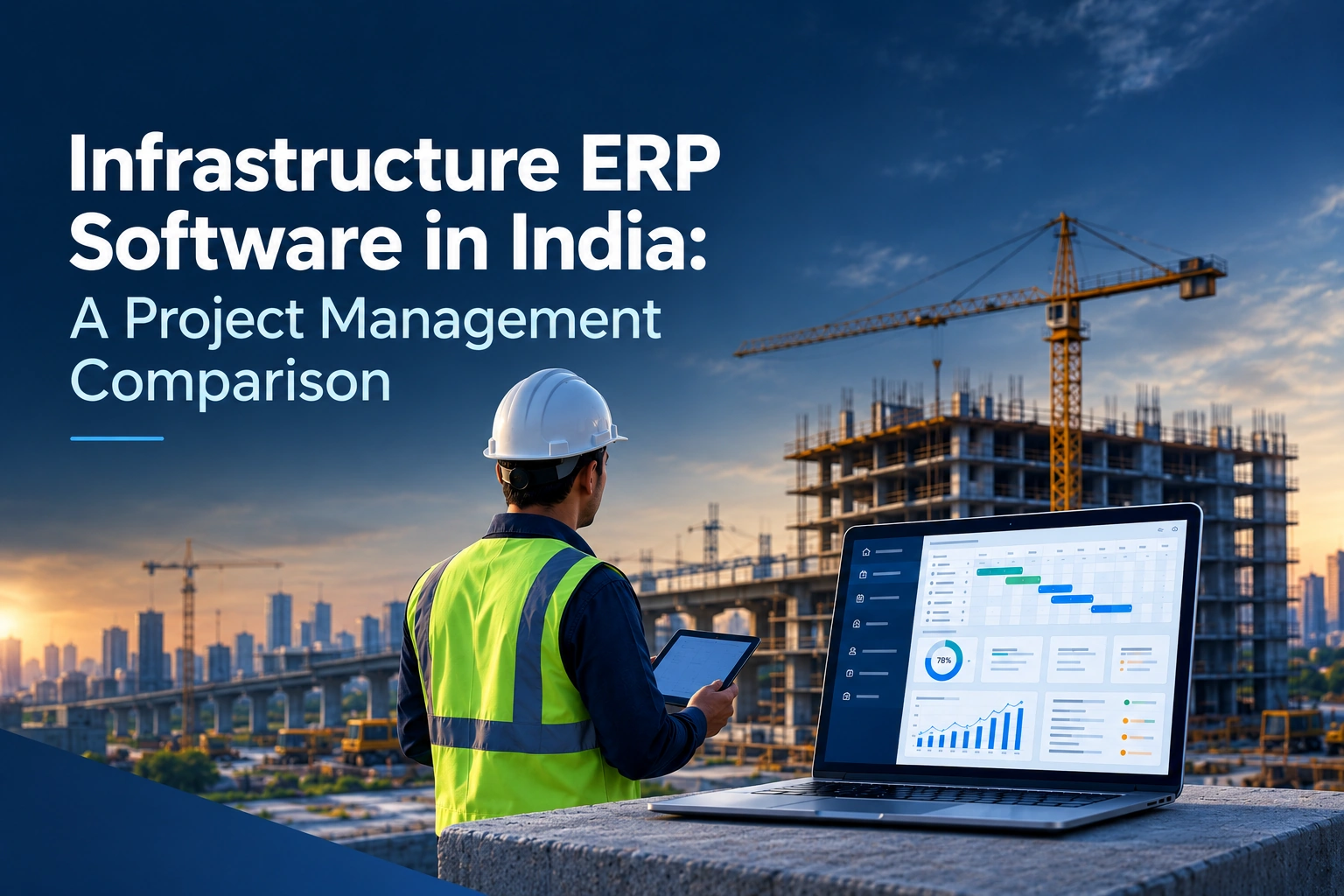
Infrastructure ERP Software in India: A Project Management Comparison
Managing an infrastructure project involves much more than tracking tasks and deadlines. Project managers have to coordinate budgets, labour, equipment, procurement, subcontractors, materials and site progress across multiple locations.
This is why choosing the right Infrastructure ERP Software in India has become important for companies managing large construction and infrastructure projects.
A good infrastructure ERP should connect project planning with execution, procurement and financial control instead of keeping each process in a separate system.
What Should Infrastructure ERP Software Include?
When comparing infrastructure ERP platforms, project-management capabilities should be evaluated across a few key areas:
-
Project planning, WBS and scheduling
-
Resource and labour allocation
-
Project budgeting and cost control
-
Procurement and material planning
-
Subcontractor and vendor management
-
Approval and compliance workflows
-
Mobile access for site teams
-
Equipment and IIoT integration
-
BI dashboards and project reporting
The most important factor is how these functions work together.
For example, a material requirement generated from a project plan should ideally flow into procurement, delivery, inventory and project costing.
For a broader explanation of this connected approach, read our guide on ERP for Contracting & Infrastructure Industry.
Infrastructure ERP Software in India: What to Compare
Different platforms approach infrastructure management differently.
Enterprise platforms such as SAP and Oracle provide broad financial, procurement and project-management capabilities. Construction-focused platforms such as Procore and Trimble Viewpoint place greater emphasis on project execution and field operations.
For Indian infrastructure companies, however, local requirements also matter. GST workflows, project-level costing, subcontractor billing, material movement, multi-site operations and local approval processes can significantly affect ERP implementation.
This makes the evaluation less about the number of features and more about how well the software fits the company's actual project workflow.
biCanvas for Infrastructure Project Management
biCanvas is an India-focused enterprise ERP designed for construction, infrastructure and other project-driven businesses.
Its project-management capabilities cover areas such as project planning, WBS, WIP, budgeting, procurement, material management, subcontractor management and project reporting.
The platform also connects procurement with project requirements. Material planning, purchase workflows, inventory and project costs can be managed within the same operational framework.
Companies can also configure approval workflows according to their business processes rather than relying entirely on fixed workflows.
For infrastructure organisations managing multiple projects, BI dashboards provide management visibility into project and operational information.
Another important capability is IIoT integration, which can connect operational equipment and plant data with enterprise processes where required.
This creates a connected flow:
Project Planning → Procurement → Material Movement → Site Execution → Cost Tracking → Management Reporting
For more detail, read How ERP Simplifies Infrastructure Project Planning.
Why Project-Level Cost Control Matters
Infrastructure projects can involve thousands of individual transactions across materials, labour, equipment, subcontractors and procurement.
A project budget alone does not provide sufficient control.
Management needs to understand:
Budget → Committed Cost → Actual Cost → Variance
An integrated ERP can make this information available at the project or activity level, helping teams identify cost deviations earlier.
Our article on Construction ERP: The Backbone of Efficient Construction Management explains how connected project, procurement and financial data can strengthen project control.
Procurement and Material Visibility
Procurement is another area where infrastructure projects frequently lose visibility.
A project may require material weeks before it is actually needed on site. If procurement is disconnected from project planning, teams may discover shortages only when work is ready to begin.
Infrastructure ERP software can connect material requirements with purchase requests, vendor quotations, purchase orders, goods receipts and inventory.
This provides a clearer chain from project requirement to material availability.
For a deeper look at this workflow, read Construction Inventory and Procurement Management.
Field Mobility Is Part of Project Control
The information shown on a management dashboard is only as reliable as the information coming from the site.
Site engineers and supervisors need to record progress, materials, labour, equipment usage and other project information while work is happening.
A mobile-enabled infrastructure ERP can reduce the delay between site activity and management visibility.
biCanvas provides mobile access for construction workflows, including site reporting and operational activities.
Read more about this in Construction ERP Mobile App for Site Engineers.
How to Choose Infrastructure ERP Software in India
Before selecting an ERP, infrastructure companies should test the platform using an actual project workflow.
Ask the vendor to demonstrate:
-
How a project is created and broken into WBS activities.
-
How schedules and progress are tracked.
-
How material requirements are generated.
-
How procurement affects project budgets.
-
How subcontractor work and billing are managed.
-
How site teams submit updates.
-
How project costs are compared with budgets.
-
How management dashboards show project performance.
-
How external systems, equipment or IIoT data can be integrated.
A software demo based on generic examples can look impressive. A demonstration using your actual project processes is much more useful.
Final Thoughts
The purpose of Infrastructure ERP Software in India is not simply to replace spreadsheets.
The real objective is to connect planning, procurement, resources, site execution and financial control so that project managers can make decisions using current information.
For Indian infrastructure and construction companies looking for a connected, project-focused ERP environment, biCanvas brings together project management, procurement, material management, budgeting, workflows, field operations, IIoT integration and BI reporting.
For a broader overview of construction ERP capabilities, explore our Construction ERP Software Guide.
The right ERP ultimately depends on project complexity, existing systems, business processes and implementation requirements.
Want to see how biCanvas can support your infrastructure projects? Request a demo and evaluate the platform against your current project workflows.
Frequently Asked Questions
What is Infrastructure ERP Software?
Infrastructure ERP software is an enterprise platform designed to connect infrastructure and construction processes such as project planning, procurement, budgeting, inventory, workforce, subcontractors, equipment and reporting.
What should Infrastructure ERP Software in India include?
It should ideally include project planning, scheduling, budgeting, procurement, material management, subcontractor management, field mobility, compliance workflows and project-level reporting.
How does ERP help control infrastructure project costs?
ERP connects project budgets with procurement, material consumption, labour, equipment and other expenses, allowing management to compare planned and actual costs and identify variances.
Can infrastructure ERP integrate with IIoT systems?
Yes. Depending on the platform and implementation, ERP systems can integrate with IIoT, equipment, GPS and other operational systems to bring physical asset data into enterprise workflows.
Why is mobile access important for infrastructure ERP?
Infrastructure work happens across project sites rather than only in offices. Mobile access allows site teams to record progress, submit information and complete workflows closer to where the work happens.
Is biCanvas suitable for infrastructure projects?
biCanvas provides infrastructure-focused capabilities covering project management, procurement, inventory, budgeting, contractor management, equipment and reporting, making it relevant for project-driven infrastructure businesses.
OUR BLOGS
Our Latest Blogs
29 Sep 2026
By Mohini Dodwade Infrastructure
Infrastructure ERP Software in India: A Project Management Comparison
Managing an infrastructure project involves much more than tracking tasks and deadlines. Project managers have to coordinate budgets, labour, equipment, procurement, subcontractors, materials and site progress across multiple locations. This is why choosing the right Infrastructure ERP Software in India has become important for companies managing large construction and infrastructure projects. A good infrastructure ERP should connect project planning with execution, procurement and financial control instead of keeping each process in a separate system. What Should Infrastructure ERP Software Include? When comparing infrastructure ERP platforms, project-management capabilities should be evaluated across a few key areas: Project planning, WBS and scheduling Resource and labour allocation Project budgeting and cost control Procurement and material planning Subcontractor and vendor management Approval and compliance workflows Mobile access for site teams Equipment and IIoT integration BI dashboards and project reporting The most important factor is how these functions work together. For example, a material requirement generated from a project plan should ideally flow into procurement, delivery, inventory and project costing. For a broader explanation of this connected approach, read our guide on ERP for Contracting & Infrastructure Industry. Infrastructure ERP Software in India: What to Compare Different platforms approach infrastructure management differently. Enterprise platforms such as SAP and Oracle provide broad financial, procurement and project-management capabilities. Construction-focused platforms such as Procore and Trimble Viewpoint place greater emphasis on project execution and field operations. For Indian infrastructure companies, however, local requirements also matter. GST workflows, project-level costing, subcontractor billing, material movement, multi-site operations and local approval processes can significantly affect ERP implementation. This makes the evaluation less about the number of features and more about how well the software fits the company's actual project workflow. biCanvas for Infrastructure Project Management biCanvas is an India-focused enterprise ERP designed for construction, infrastructure and other project-driven businesses. Its project-management capabilities cover areas such as project planning, WBS, WIP, budgeting, procurement, material management, subcontractor management and project reporting. The platform also connects procurement with project requirements. Material planning, purchase workflows, inventory and project costs can be managed within the same operational framework. Companies can also configure approval workflows according to their business processes rather than relying entirely on fixed workflows. For infrastructure organisations managing multiple projects, BI dashboards provide management visibility into project and operational information. Another important capability is IIoT integration, which can connect operational equipment and plant data with enterprise processes where required. This creates a connected flow: Project Planning → Procurement → Material Movement → Site Execution → Cost Tracking → Management Reporting For more detail, read How ERP Simplifies Infrastructure Project Planning. Why Project-Level Cost Control Matters Infrastructure projects can involve thousands of individual transactions across materials, labour, equipment, subcontractors and procurement. A project budget alone does not provide sufficient control. Management needs to understand: Budget → Committed Cost → Actual Cost → Variance An integrated ERP can make this information available at the project or activity level, helping teams identify cost deviations earlier. Our article on Construction ERP: The Backbone of Efficient Construction Management explains how connected project, procurement and financial data can strengthen project control. Procurement and Material Visibility Procurement is another area where infrastructure projects frequently lose visibility. A project may require material weeks before it is actually needed on site. If procurement is disconnected from project planning, teams may discover shortages only when work is ready to begin. Infrastructure ERP software can connect material requirements with purchase requests, vendor quotations, purchase orders, goods receipts and inventory. This provides a clearer chain from project requirement to material availability. For a deeper look at this workflow, read Construction Inventory and Procurement Management. Field Mobility Is Part of Project Control The information shown on a management dashboard is only as reliable as the information coming from the site. Site engineers and supervisors need to record progress, materials, labour, equipment usage and other project information while work is happening. A mobile-enabled infrastructure ERP can reduce the delay between site activity and management visibility. biCanvas provides mobile access for construction workflows, including site reporting and operational activities. Read more about this in Construction ERP Mobile App for Site Engineers. How to Choose Infrastructure ERP Software in India Before selecting an ERP, infrastructure companies should test the platform using an actual project workflow. Ask the vendor to demonstrate: How a project is created and broken into WBS activities. How schedules and progress are tracked. How material requirements are generated. How procurement affects project budgets. How subcontractor work and billing are managed. How site teams submit updates. How project costs are compared with budgets. How management dashboards show project performance. How external systems, equipment or IIoT data can be integrated. A software demo based on generic examples can look impressive. A demonstration using your actual project processes is much more useful. Final Thoughts The purpose of Infrastructure ERP Software in India is not simply to replace spreadsheets. The real objective is to connect planning, procurement, resources, site execution and financial control so that project managers can make decisions using current information. For Indian infrastructure and construction companies looking for a connected, project-focused ERP environment, biCanvas brings together project management, procurement, material management, budgeting, workflows, field operations, IIoT integration and BI reporting. For a broader overview of construction ERP capabilities, explore our Construction ERP Software Guide. The right ERP ultimately depends on project complexity, existing systems, business processes and implementation requirements. Want to see how biCanvas can support your infrastructure projects? Request a demo and evaluate the platform against your current project workflows. Frequently Asked Questions What is Infrastructure ERP Software? Infrastructure ERP software is an enterprise platform designed to connect infrastructure and construction processes such as project planning, procurement, budgeting, inventory, workforce, subcontractors, equipment and reporting. What should Infrastructure ERP Software in India include? It should ideally include project planning, scheduling, budgeting, procurement, material management, subcontractor management, field mobility, compliance workflows and project-level reporting. How does ERP help control infrastructure project costs? ERP connects project budgets with procurement, material consumption, labour, equipment and other expenses, allowing management to compare planned and actual costs and identify variances. Can infrastructure ERP integrate with IIoT systems? Yes. Depending on the platform and implementation, ERP systems can integrate with IIoT, equipment, GPS and other operational systems to bring physical asset data into enterprise workflows. Why is mobile access important for infrastructure ERP? Infrastructure work happens across project sites rather than only in offices. Mobile access allows site teams to record progress, submit information and complete workflows closer to where the work happens. Is biCanvas suitable for infrastructure projects? biCanvas provides infrastructure-focused capabilities covering project management, procurement, inventory, budgeting, contractor management, equipment and reporting, making it relevant for project-driven infrastructure businesses.
OUR BLOGS
Our Latest Blogs
18 Nov 2026
By Mohini Dodwade Construction
New Labour Codes in India: How Construction ERP Software Simplifies Contractor Compliance
India's construction sector depends on large, mobile and contract-based workforces. That is exactly why the new Labour Codes matter so much to builders, infrastructure companies and ready-mix concrete (RMC) operators. The four codes came into force on 21 November 2025 and replaced 29 central labour laws. The Central Rules under them were notified on 8 May 2026, so contractors are now dealing with day-to-day compliance, not just headlines. If your labour data still lives in spreadsheets, muster rolls and WhatsApp groups, this shift is a real operational risk. This guide explains what changes for construction companies and how construction ERP software in India helps you stay compliant without slowing down the site. Why the Labour Codes Matter for Construction Before the reform, construction labour was governed by a patchwork of laws covering minimum wages, contract labour, compensation, and the welfare of building and other construction workers. The new framework consolidates these into four codes with uniform definitions and wider coverage. For contractors, three things stand out: Higher compliance expectations: Registrations, returns and employer duties apply to principal employers and contractors alike. Possible cost impact: One industry report estimates that real estate labour costs could rise by 8–12% as developers adjust. More documentation: Wage records, attendance and contractor details need to be accurate and easy to produce. Specifics can differ by state and by how a company is structured, so confirm your obligations with your legal or HR advisor. What Changes on the Ground 1. Payroll and wage structure The wage definition affects how allowances are treated when calculating provident fund, gratuity and similar benefits. Companies may need to restructure salary components and recalculate contributions. 2. Contract labour and principal employer responsibility Construction relies heavily on subcontractors. Under the new framework, principal employers need clearer visibility into who is working on their sites and whether their contractors are paying wages and statutory dues correctly. Companies should also review their existing labour management processes for construction projects to identify gaps in attendance tracking, wage calculations and contractor records. 3. Migrant workers The codes widen the definition of inter-state migrant workers to include those hired directly, through contractors, or who migrate on their own. Sites with workers from several states need accurate records for each of them. 4. Contractor registration and licensing Several states have been drafting rules for formal contractor registration and licensing, which makes contractor records more important for audits and approvals. 5. Records, registers and returns More of your labour data must be available, accurate and traceable on demand. Where Manual Systems Break Down Most compliance problems in construction are not caused by bad intent. They come from scattered information: Attendance is captured on paper at each site and entered later at head office. Contractor bills are verified against headcount that nobody can cross-check quickly. PF and ESIC data sits in separate files from payroll. Labour cost does not connect to project progress, so overruns appear only at month-end. When audits, disputes or inspections arise, assembling clean records takes days. Fragmented data is the real compliance risk. This is also one of the reasons why companies should evaluate their existing systems before investing in new technology. Our construction ERP selection checklist for India explains the important factors businesses should consider when assessing workforce management, procurement, budgeting and project control capabilities. How Construction ERP Software in India Helps A purpose-built system connects labour, cost, progress and approvals in one place. Here is what that looks like in practice. Labour management software for construction Track workers, attendance and wages by site and contractor. Link contractor billing to verified headcount, and keep PF and ESIC details alongside payroll so records stay consistent. A connected ERP can also bring workforce processes together with other operational functions. Explore the key modules included in a comprehensive construction ERP to understand how different departments can operate through a unified platform. Multi-level approvals and audit trails Every wage release, contractor bill or expense can follow a defined approval chain with time-stamped actions. When someone asks who approved a payment, the answer is in the system. Daily progress linked to labour When Daily Progress Reports capture manpower alongside work done, you can see labour productivity and cost per activity, not just total headcount. Real-time cost visibility Business intelligence dashboards help management see labour cost against budget across projects, so that higher compliance costs are visible early and can be planned for. Understanding the relationship between operational expenditure and project profitability is equally important. Our construction ERP ROI calculator explains how businesses can assess potential savings from improved labour management, material control and operational efficiency. One source of truth Instead of reconciling spreadsheets at month-end, finance, HR and site teams work from the same data. That is what makes construction company software valuable during an audit or inspection. Special Considerations for RMC Plants A ready mix concrete ERP has its own labour dimension. RMC businesses run plants, fleets and delivery operations with plant operators, drivers, helpers and contract staff working in shifts. Accurate attendance, shift records and contractor payments matter just as much here as on a construction site. An ERP that handles production, dispatch and workforce data together makes it easier to keep records consistent across plant and site. For businesses comparing software solutions, understanding the ERP software requirements for the construction industry in India can also help identify the importance of integrated operations and industry-specific workflows. What to Look For in the Best ERP Software for Construction When comparing the best ERP software for construction or the best construction ERP software, look beyond feature lists and ask how each system handles real labour workflows: Does it manage attendance, wages and contractor billing in one place? Can it support statutory data such as PF and ESIC? Does it offer configurable approval workflows and audit trails? Does it link labour data to project progress and cost? Does it work through a mobile app for site teams? Can it adapt as rules change? The best ERP software for construction industry teams is the one that fits how your sites actually operate, with fast setup and minimal custom work. Cost is another important consideration. Before making a decision, businesses should understand implementation, training, customisation and maintenance expenses. Our guide to construction ERP pricing in India in 2026 provides a breakdown of the different cost components involved in ERP implementation. A Practical Checklist to Get Started Review your current wage structure and payroll components with your advisor. List all active contractors and the workers deployed through them. Check that attendance and wage records are consistent across sites. Identify where labour data is still manual or duplicated. Set approval workflows for wage release and contractor payments. Choose a system that connects labour data to project cost and progress. Related Reading from biCanvas Construction ERP Selection Checklist for India: 7 Things to Evaluate Before You Buy What Are the Key Modules Included in a Comprehensive Construction ERP? Construction ERP Pricing in India 2026: Full Breakdown + Hidden Costs Construction ERP ROI Calculator: How Much Can You Actually Save? Labour Management System Software for Construction ERP Software for Construction Industry in India Final Thoughts The new Labour Codes raise the standard for record-keeping and accountability across the construction industry. Companies that treat compliance as a data problem, not a paperwork problem, will adapt faster and with fewer surprises. biCanvas helps construction, infrastructure and ready-mix concrete companies connect labour, procurement, inventory, finance and project progress in one platform. If you're evaluating construction ERP software in India to simplify compliance and control labour costs, book a free demo to see how it works for your projects.
OUR BLOGS
Our Latest Blogs
31 Aug 2026
By Mohini Dodwade Manufacturing
Manufacturing Inventory Management Software: Connecting Stock to Production
A production line does not stop because a plant ran out of raw material. It stops because nobody knew the raw material was running low until the line was already waiting on it. Most manufacturers can tell you what is sitting in their warehouse on any given day, but far fewer can tell you what that stock actually means for tomorrow's production schedule. That gap between knowing what you have and knowing what it will let you produce is exactly the problem manufacturing inventory management software is built to close. Why Spreadsheet Inventory Breaks Down as Production Scales A small manufacturing operation can often get away with tracking stock in a spreadsheet or a basic accounting tool. The moment a plant runs multiple production lines, multiple shifts, or multiple raw material vendors, that approach falls apart. Stock counts go stale between updates, nobody has a single view of what is committed to a pending work order versus what is genuinely available, and reordering becomes reactive instead of planned. Manufacturing inventory management software exists to remove that lag. It gives a plant a live view of stock as it moves, not a snapshot from the last time someone updated a spreadsheet. What Manufacturing Inventory Management Software Actually Needs to Do For a manufacturer running real production volume, inventory software has to do more than count units sitting in a warehouse. It needs to connect stock directly to what the plant is actually producing. Real-time raw material tracking that updates automatically as material is consumed on the line, not through manual entry after the fact Production-linked stock visibility, so a plant knows exactly how much of a raw material is already committed to open work orders versus genuinely free to allocate Batch and lot tracking for traceability, particularly important for manufacturers who need to trace a finished product back to a specific raw material batch Automated reorder triggers based on actual consumption patterns and lead times, not fixed reorder points that ignore how demand actually moves When these pieces are connected, a plant manager stops reacting to shortages and starts seeing them coming days or weeks in advance. Connecting Inventory to What Happens on the Shop Floor Inventory data on its own is only half the picture. The real value comes from connecting stock levels directly to shop floor activity, so a drop in raw material shows up against the production schedule immediately instead of surfacing as a surprise when a line supervisor goes looking for material that is not there. We cover this connection in detail in our piece on automating the shop floor with ERP, where the core argument is that disconnected systems, not missing processes, are usually what cause manufacturing inefficiency. Manufacturing inventory management software is one half of that connection. Without it feeding directly into production planning, even a well-run shop floor is still operating on incomplete information about what it can actually build next. Where This Differs From MES It is worth being clear about what manufacturing inventory management software is not. A Manufacturing Execution System tracks what is happening on the line in real time, machine status, work-in-progress, and quality checkpoints. Inventory management software tracks the material feeding into and out of that process. Our comparison of manufacturing ERP versus manufacturing execution software breaks down where each system's responsibility starts and ends, and the short version is that inventory and MES need to work together, not compete for the same job. A manufacturer evaluating software should be clear on which gap they are actually trying to close before comparing vendors, since a strong MES with weak inventory visibility still leaves material shortages as a blind spot, and the reverse is equally true. Batch Tracking and Traceability Are Not Optional Anymore For manufacturers supplying regulated industries, or working with clients who require material traceability, batch and lot tracking is not a nice-to-have feature. It needs to be built into the core inventory system, not managed as a separate compliance exercise after production is complete. This matters just as much for manufacturers connected to construction supply chains, where a batch of material needs to be traceable back through the plant to the original raw material lot if a quality issue surfaces on site months later. Manufacturing inventory management software that captures batch data automatically as material moves through production removes the need for manual traceability logs that are easy to fall behind on and difficult to audit later. Where Inventory Fits Into the Broader Supply Chain Manufacturing inventory does not exist in isolation from procurement and logistics. A plant's raw material stock is the downstream result of vendor reliability, delivery timing, and demand forecasting further up the chain. We cover this broader connection in our guide on supply chain management software for construction, and the same principle applies directly to manufacturing: inventory visibility is only as useful as the procurement and logistics data feeding into it. A plant with excellent internal inventory tracking but no visibility into incoming vendor deliveries is still flying blind on the timing side of the equation. What to Evaluate Before Choosing Manufacturing Inventory Management Software Before committing to a platform, check whether it actually connects to production planning or simply counts stock as a standalone function. Confirm whether batch and lot tracking is native to the system rather than a manual add-on process. And check whether reorder logic is based on real consumption patterns and vendor lead times, rather than static reorder points that need constant manual adjustment as demand shifts. How biCanvas Approaches Manufacturing Inventory Management biCanvas connects raw material inventory directly to production planning and work orders, so stock consumption updates automatically as production moves rather than through manual reconciliation at shift end. Batch and lot data is captured as part of the same workflow, giving manufacturers traceability without a separate compliance process running alongside production. Because inventory is tied to the same system managing procurement and vendor data, plant managers get a single view from incoming material to finished output, instead of stitching together answers from separate tools. If your plant is still reconciling stock manually against a production schedule that changes daily, you can book a personalised demo to see how connected inventory tracking works against your own production setup. Frequently Asked Questions Is manufacturing inventory management software the same as an MES? No. An MES tracks real-time activity on the production line itself, while inventory management software tracks the raw material and finished goods stock feeding into and out of that process. They are meant to work together, not replace each other. Does manufacturing inventory management software help with material shortages? Yes, by connecting stock levels directly to production schedules and consumption patterns, it flags potential shortages days or weeks in advance instead of when a line is already waiting on material. Why does batch tracking matter for manufacturers who are not in a regulated industry? Even outside regulated sectors, batch tracking makes it possible to trace a quality issue in a finished product back to its raw material source, which matters for any manufacturer supplying clients who expect accountability if something goes wrong downstream.
OUR BLOGS
Our Latest Blogs
23 Oct 2026
By Mohini Dodwade Ready Mix Concrete
Ready Mix Concrete ERP: Connecting Production, Inventory and Delivery
Ready Mix Concrete (RMC) businesses operate in a time-sensitive environment where production planning, raw material availability, plant operations, transportation and customer delivery must work together. Even a small disruption in one area can affect several activities across the business. For example, a shortage of cement can delay batching, an unexpected change in a project's concrete requirement can disrupt dispatch schedules, and poor coordination between the plant and transport teams can lead to unnecessary waiting time. These challenges become more difficult when different teams maintain separate spreadsheets, paper records or disconnected applications. This is where ready mix concrete ERP becomes valuable. By connecting key operational activities in one system, an ERP platform can help RMC businesses improve coordination, monitor resources and make decisions using more consistent information. For a broader understanding of how ERP connects construction operations, explore biCanvas's complete guide to construction ERP software. Why Ready Mix Concrete Businesses Need Connected Operations Unlike many other construction materials, ready-mix concrete must be produced and delivered according to specific project requirements and schedules. Production and delivery planning therefore depend on more than the availability of raw materials. RMC businesses must coordinate several activities simultaneously: Monitoring cement, sand, aggregates and admixture availability. Planning production according to confirmed orders and site requirements. Coordinating batching plant operations and equipment. Scheduling vehicles and deliveries. Tracking fuel, transportation and operational costs. Maintaining purchase, inventory and delivery records. When these activities operate independently, teams may have difficulty identifying where delays originate or how operational decisions affect costs. A connected system creates a more consistent flow of information between departments, allowing managers to monitor operations without waiting for multiple teams to compile separate reports. 1. Connect Production Planning with Actual Demand Production planning is one of the most important responsibilities in an RMC business. The plant must produce the required concrete quantity while considering delivery schedules, available resources and customer specifications. Planning production without reliable order information can create two problems: insufficient concrete when a project needs it, or unnecessary production that puts pressure on plant capacity and scheduling. An ERP system can help connect order information, production requirements, material availability and operational schedules. For example, when a construction site requests concrete for a scheduled pour, the operations team can use the available order and planning information to coordinate production and dispatch. If the requirement changes, the relevant teams can review the updated plan rather than relying entirely on separate calls and spreadsheets. The objective is not simply to produce more concrete. It is to align production with actual demand and available capacity. 2. Improve Raw Material Inventory Visibility Cement, aggregates, sand and chemical admixtures are essential inputs for RMC production. Inaccurate inventory records can affect production schedules, purchasing decisions and cost calculations. Manual inventory management often creates a gap between recorded stock and the quantity physically available at the plant. A suitable ERP system can help businesses maintain structured records of material receipts, stock movements, consumption and replenishment requirements. This can support better decisions in several ways: Stock visibility: Review available material quantities before confirming production plans. Purchase planning: Identify replenishment requirements earlier. Consumption monitoring: Compare expected and recorded material usage. Stock reconciliation: Investigate differences between system records and physical quantities. Cost visibility: Connect material movements with operational and financial reporting. These controls are particularly useful when businesses operate multiple plants or supply several construction sites. For more practical insights into material tracking, read biCanvas's guide to construction material management and inventory control. It provides additional context on how material procurement and inventory processes contribute to better construction operations. 3. Coordinate Dispatch and Transportation Production alone does not complete an RMC order. Concrete must reach the right site, in the required quantity, at the appropriate time. Dispatch planning becomes complicated when multiple customers request deliveries within overlapping time windows. Traffic conditions, plant capacity, vehicle availability and changing site requirements can add further pressure. A connected operational system can help teams coordinate dispatch schedules, order details, vehicle allocation and delivery records. For instance, if a site changes its requested delivery time, the operations team needs reliable information to assess the impact on production and other scheduled deliveries. Better coordination can help reduce avoidable waiting, improve communication between the plant and site teams, and make delivery planning more predictable. Businesses should also evaluate whether their chosen platform supports the specific vehicle tracking, weighbridge, batching or transport integrations required by their operations. 4. Monitor Plant, Machinery and Fuel Costs Plant and machinery are important operational resources for RMC businesses. Their availability, maintenance requirements and operating expenses influence productivity. Unexpected equipment downtime can interrupt production and affect delivery commitments. Meanwhile, limited visibility into fuel consumption and maintenance expenditure can make it harder to understand the true cost of operations. An ERP platform with appropriate equipment and asset management capabilities can help businesses maintain equipment records, monitor maintenance activities and track related expenses. Depending on the system configuration, businesses may also integrate equipment or telematics data to analyse utilisation and fuel consumption. The practical benefit is better visibility into recurring operational issues. Managers can identify equipment that requires attention, review maintenance expenditure and evaluate whether resources are being used efficiently. For businesses handling large infrastructure projects, biCanvas also provides insights into construction ERP software for infrastructure businesses, including the importance of evaluating operational requirements before choosing an ERP platform. 5. Connect Plant Operations with Project Requirements RMC suppliers often serve several construction projects with different delivery schedules, concrete grades and quantity requirements. Coordination becomes more demanding when multiple sites depend on the same plant or fleet. This is where construction company software with suitable RMC capabilities can help connect supplier operations with broader construction workflows. A connected system can support coordination between order information, project requirements, dispatch records, material availability and financial reporting. For construction and infrastructure businesses that manage their own RMC operations, this connection can provide a more complete view of how material supply affects project execution. For example, a delayed delivery may affect the site's planned activities. If the relevant teams can access consistent operational information, they can respond sooner and make more informed scheduling decisions. Businesses looking to connect these processes across departments can also explore how biCanvas connects projects, inventory, workforce and operations in India. 6. Improve Cost and Performance Reporting Operational activity generates information about material consumption, production, dispatch, transport and equipment expenses. However, information is useful only when it can be interpreted and connected to business decisions. When reports are prepared manually from separate systems, management may spend considerable time reconciling figures before analysing performance. An integrated ERP environment can help consolidate operational records and provide more structured reporting. Useful performance indicators may include: Planned versus actual production quantities. Raw material consumption and stock variances. Delivery punctuality and vehicle utilisation. Fuel and maintenance expenditure. Plant operating costs. Order fulfilment and outstanding deliveries. The exact indicators depend on the business model, available data and system configuration. Regular reporting helps managers identify recurring bottlenecks, compare performance over time and take corrective action based on evidence rather than assumptions. 7. What Should You Evaluate Before Choosing an RMC ERP? Not every ERP platform supports the operational requirements of a ready-mix concrete business equally well. Before selecting a solution, businesses should evaluate the workflows they need to manage and the integrations required to support them. Consider these questions: Production: Can the system support the production planning and batching workflows your plant requires? Inventory: Can it track raw materials, receipts, consumption and stock reconciliation? Dispatch: Can the team coordinate orders, delivery schedules and dispatch records? Transportation: Does it support the required vehicle, fuel and tracking integrations? Equipment: Can plant machinery, maintenance and operating costs be monitored? Reporting: Can management review operational performance and costs using consistent information? Scalability: Can the system support additional plants, customers and operating locations as the business grows? Implementation: What training, configuration, integration and ongoing support will be required? For a wider evaluation framework, read biCanvas's construction ERP software guide. It explains how connected construction processes can help businesses assess their requirements before choosing a solution. These questions help businesses evaluate software against real operating conditions instead of selecting a product solely because it has an extensive feature list. How biCanvas Supports RMC and Construction Operations biCanvas provides ERP capabilities for construction, infrastructure and ready-mix concrete operations. Its RMC offering covers areas including production planning, material and inventory management, transportation and fuel tracking, plant and machinery management, and purchase management. These capabilities are relevant to businesses seeking better coordination across plant and operational activities. For organisations that also manage construction or infrastructure projects, connecting relevant operational information can help reduce the need to rely on disconnected processes. Explore the biCanvas construction ERP solution to learn more about its project management, finance, inventory, resource allocation and equipment management capabilities. Businesses can also review construction ERP software in India: how biCanvas connects projects, inventory, workforce and operations for a broader understanding of how construction-focused ERP can support connected business processes. The right solution will depend on the organisation's operating model, plant requirements, existing systems and implementation priorities. Conclusion Ready mix concrete operations depend on the coordination of production, raw materials, transportation, equipment and delivery schedules. When these activities are managed through disconnected systems, even routine changes can create delays and make costs harder to understand. A suitable ready mix concrete ERP can help businesses connect operational information, improve inventory visibility, coordinate dispatch and strengthen performance reporting. For RMC suppliers, construction contractors and infrastructure businesses, the goal is to build a reliable flow of information from planning through execution and reporting. biCanvas offers construction and RMC-focused ERP capabilities that businesses can evaluate against these requirements. The best starting point is to identify the operational gaps that affect your business most and determine which workflows need to work together. Frequently Asked Questions 1. What is ready mix concrete ERP? Ready mix concrete ERP is a business management system that helps coordinate RMC activities such as production planning, raw material inventory, dispatch, transportation, equipment management and operational reporting. 2. What are the benefits of using ready mix concrete ERP? Depending on its capabilities and implementation, an RMC ERP can improve inventory visibility, production coordination, dispatch planning, cost monitoring and reporting. It can also help teams work with more consistent operational information. 3. Can construction company software manage RMC operations? Some construction ERP platforms support RMC operations alongside project management, inventory, procurement and finance. Businesses should verify that the chosen platform covers their specific production, batching, dispatch and transport requirements. 4. What is the difference between construction ERP and infrastructure ERP? Construction ERP generally supports project execution, procurement, inventory, budgeting and related business processes. Infrastructure ERP focuses on the requirements of infrastructure projects, which may include multi-site coordination, contracts, resource allocation, equipment and project-level financial control. The capabilities of individual platforms vary. To understand how these requirements affect software selection, read biCanvas's guide to construction ERP for infrastructure businesses. 5. How does biCanvas support ready mix concrete businesses? biCanvas offers RMC-focused capabilities covering production planning, inventory and material management, transportation and fuel tracking, plant and machinery management, and purchasing. Businesses should assess the available configuration and integrations against their operational requirements. 6. How should a business choose the right RMC ERP? Start by mapping current workflows and identifying operational gaps. Then evaluate production planning, inventory controls, dispatch, transportation, equipment management, reporting, integrations, implementation requirements and scalability before making a decision.
Search
Blog Categories
Recent Posts

Post 01
Construction Document Control in Construction Projects: Managing Drawings, Revisions and Site Communication
23 Nov 2026

Post 02
AI-Powered Highway Monitoring: How Technology Is Transforming Infrastructure Management in India
21 Nov 2026

Post 03
New Labour Codes in India: How Construction ERP Software Simplifies Contractor Compliance
18 Nov 2026